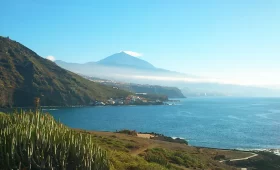
The possibility of seeing a Mount Teide eruption has captured the attention of scientists, media and citizens in recent months. Located on the island of Tenerife in the Canary Islands, Teide is one of the most emblematic and closely watched volcanoes in the world. Recently, earthquake swarms and ‘anomalous’ volcanic activity have been recorded, raising questions about its possible reactivation: Is Teide volcano active? Is it about to erupt? When was Mount Teide last eruption? In this article, we try to answer all these and many other questions by listening to what the experts say.
🌍 What is happening on the Teide volcano?
In recent months, seismologists have detected a series of seismic swarms at the Teide volcano. These swarms consist of multiple small earthquakes occurring in a short period of time and in a specific area.
According to data from the Volcanological Institute of the Canary Islands (INVOLCAN), hundreds of micro-earthquakes have been recorded in recent months at depths of 17 to 40 km, with magnitudes ranging from 1.5 to 3.6 on the Richter scale. The tremors are mainly located in the areas of Las Cañadas, Cumbres de Adeje, Vilaflor and – to a lesser extent – Izaña and the summits of Arico. In fact, there has been an increase in seismic activity on Teide since 2016, which has accelerated since 2022.
In addition, an increase in the emission of volcanic gases, especially carbon dioxide (CO₂), has been observed, suggesting that the magmatic system of Teide is undergoing changes. Ground deformation has also been detected since 2023, in some areas up to 1 cm. Although these phenomena are common in active volcanoes, the frequency and intensity have caught the attention of scientists and forced them to redouble their monitoring of the volcano, as they could be signs of increased pressure in the hydrothermal system beneath the island of Tenerife.
🔥 So, is Mount Teide an active volcano?
Yes, Teide is an active volcano. Although the last Teide eruption occurred a century ago, volcanoes are considered active if they have been active for the last 10,000 years. Teide, with a height of 3,715 metres, is in fact not only the highest peak in Spain, but also one of the most studied volcanoes in the world.
Its geological history is good proof of its activity, as it is estimated that Teide has erupted at least 13 times in the last 2,000 years; the most recent historic eruptions in Tenerife’s Mount Teide occurred in 1492, 1704, 1706, 1798 and finally in 1909. This makes it a potentially dangerous volcanic system.
🤔 What do seismologists say about ‘anomalous’ volcanic activity?
Scientists from the Canary Islands Volcanic Emergency Plan (PEVOLCA) have described the recent activity as ‘anomalous’ but not necessarily worrying. According to the experts, the earthquake swarms and rising gases are indications that Teide’s magmatic system could be in motion, but there is no evidence that an eruption is imminent.
Seismologists have explained that these phenomena may be part of a normal cycle of adjustment inside the volcano, whose activity cycles are not yet well understood. However, they stressed the importance of constant vigilance, as volcanoes can change rapidly. Moreover, while experts insist that an imminent eruption is not probable, they acknowledge that the recent activity increases the likelihood that the volcano will erupt in the medium to long term.

🌋 What are the similarities with the eruption of La Palma in 2021?
The eruption of the Cumbre Vieja volcano on La Palma in 2021 has served as a reference point for scientists studying volcanoes around the world, and so has Teide. Both volcanoes share similar characteristics, such as the presence of pre-eruption seismic swarms and an increase in gas emissions. However, there are key differences:
- On La Palma, the earthquakes were shallower and increased in intensity and frequency before the eruption.
- On Teide, the earthquakes are deeper and have not shown such a clear pattern of intensification.
Thus, although there are certain similarities, both cases present a different evolution and characteristics, and experts insist that each volcano is unique. Already during the 2021 eruption on La Palma, the idea was raised that it could affect Teide; but the truth is that the two volcanoes do not even share the same magma chamber.
❓ Is Mount Teide about to erupt?
The million-dollar question: Is a Tenerife’s Mount Teide eruption possible? The short answer is yes… But there are currently no indications that this will happen in the short term. Scientists believe that, although the current activity is unusual, no clear signs of an imminent eruption, such as major ground deformations or a significant increase in ground temperature, have been detected.
However, it is clear that Teide may erupt in the future, as it is an active volcano. The key is vigilance… And preparedness
🔍 What would be the signs of an eruption on Teide?
Indications of a possible eruption of the Teide volcano include:
- Increase in the frequency and intensity of earthquakes.
- Ground deformation, detected by GPS and satellites.
- Changes in gas emissions, especially an increase in sulphur dioxide (SO₂).
- Increased temperature in fumaroles and the ground.
So far, only some of these signs have been observed, but not at alarming levels, so we can be reassured.
⏳ When did Mount Teide last erupt?
What happened when Mount Teide erupted in 1909? It was in this year that Teide volcano last eruption occurred; known as the Chinyero eruption, it was a relatively small eruption in the northwest of the island, which lasted only 10 days and caused no significant damage, leaving a volcanic cone that is currently inactive.
However, Teide has had larger eruptions in the past, such as the Montaña Blanca eruption some 2,000 years ago. Occurring within the current boundaries of the National Park, it generated a volcanic cone by accumulation of pyroclasts 2750 metres high, which today can be visited on foot.

🗓️ When could the next eruption of Mount Teide be?
Predicting the Mount Teide volcano next eruption is impossible with current technology. Volcanoes do not follow a calendar, and although scientists can monitor signs of activity, with current knowledge of geology it is not possible to determine exactly when an eruption will occur.
However, we can come closer to this answer thanks to a study published in 2012 by the geologist Joan Martí, which analysed with scientific data the probability of Teide erupting in the coming years. It concluded that the probability of an eruption equal to or greater than the one that originated 2,000 years ago Montaña Blanca (with an estimated magnitude of 5.3) is 2.1% in the next 20 years and 5.1% in the next 50 years, rising to 10% in the next century.
But if we consider the probability of an eruption of any kind before the year 2060 of this century, the chances soar to 11.1%. That is not small.
😲 What would happen to Tenerife if Mount Teide erupts?
Joan Martí’s research also focused on the possible consequences for the island of an eruption of Mount Teide. It was concluded that the southern flank of the island would be protected thanks to the natural barrier created by the Las Cañadas caldera; but the northeast of Tenerife, where cities such as Santa Cruz de Tenerife and San Cristóbal de La Laguna are located, would be at risk.
The study also warned of the exposure of the valleys of Icod and La Orotava – on the northern slopes of Tenerife – to lava flows, which could advance from the volcano towards the coast through these regions. These areas are densely populated, with more than 900,000 inhabitants.
⛰️ The Teide volcano: a sleeping giant
While scientists continue to monitor every movement, the inhabitants of Tenerife and the Canary Islands can remain calm, but always alert. Volcanoes are part of the nature of the Canary Islands, and we have to get used to living with them, and the geological history of Teide reminds us that it is an active volcano that requires constant vigilance.
A Mount Teide eruption is currently a scenario that, although possible, does not seem close at present on the basis of current data. Recent activity, although anomalous, has shown no clear signs of an imminent eruption. However, El Teide, like a sleeping giant, is once again reminding us of the importance of knowing it, respecting it and understanding its power. 🌋