Sancocho is one of the most emblematic dishes of the Canary Islands, a tasty but sober-looking recipe that reflects the rich cultural and gastronomic heritage accumulated over centuries in this archipelago. For lovers of gastronomic tourism, the sancocho recipe is not just another meal, but an experience that allows you to connect with the traditions and customs of the islands. Join us on this tour of its origins and ingredients, and discover how to prepare it.
🥣 Origins and history of the sancocho
The sancocho canario has its roots deeply intertwined in the lives of the most humble families in the Canary Islands. The origin of the dish arose as a preparation intended to take advantage of the most accessible ingredients, at a time when the agricultural and fishing economy was predominant on the islands. Its history therefore dates back to a time when fishermen used the leftovers from their daily catch to make a nutritious stew that could feed the whole family.
The word “sancocho” comes from the term “sancochado“, which means half-cooked, and its use spread in Canarian culture as a way of describing this salted fish stew with potatoes, sweet potatoes and mojo, often also accompanied by gofio mixed with fish sauce. Although it is a dish that is eaten all year round, it takes on special significance during Holy Week and especially on Good Friday, when, according to Christian tradition, meat should be avoided and fish becomes the main ingredient in the diet.
Over the years, the Canarian sancocho has evolved, but always maintaining its ingredients and traditional essence. It is believed that the recipe originally came to the Canary Islands from Spain’s mainland, and from the islands it arrived in South America, where all the variants that exist today in Latin America were born.
🥔 Ingredients of the sancocho canario
The ingredients of sancocho canario are simple but full of flavour, and each of them adds a particular touch to the recipe. The base of this dish is salted fish, usually sea bass or wreckfish, which is desalted and simmered to make the meat tender and juicy. This desalting process can take several hours, but it is crucial to achieve the characteristic flavour of sancocho.
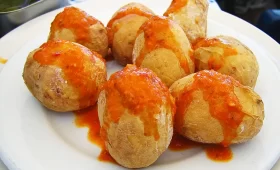
In addition to the fish, the Canarian sancocho has potatoes and sweet potatoes, which are cooked with the fish and absorb part of its salty flavour. The potatoes (papas), one of the most emblematic products of Canarian gastronomy, add consistency to the dish, while the sweet potatoes add a sweet touch that contrasts perfectly with the saltiness of the fish.
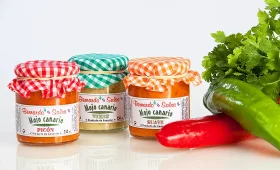
The final touch is provided by the mojo, a typical Canarian sauce made from garlic, oil, vinegar, paprika and cumin, which is served as an accompaniment to the sancocho. Although there are two types of mojo, red and green, the most common in Canarian sancocho is the green mojo, which adds freshness and an acidic touch to the whole dish that contrasts very well with the flavour of the fish.
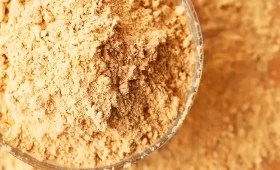
Finally, we cannot forget gofio, a flour made from toasted cereals that is served as an accompaniment or mixed with broth from the sancocho itself, to form a paste that is eaten with the fish and potatoes.
🍽️ Recipe of the sancocho canario
Preparing a Canarian sancocho is not complicated, but it does require patience, especially in the process of desalting the fish. Here are the basic steps so that you can enjoy this Canarian dish at home:
- Desalt the fish: place salted fish in cold water for 24 to 48 hours, changing the water several times to reduce the salt level. This step is crucial to bring the fish to its exact saltiness.
- Cook the potatoes and sweet potatoes: in a large pot, boil water and cook the potatoes and sweet potatoes whole, unpeeled, until tender. Drain and set aside.
- Cook the fish: in the same water in which you cooked the potatoes, add the desalted fish and cook over medium heat until cooked but firm. Cooking time will depend on the thickness of the fish.
- Prepare the mojo verde sauce: in a mortar or blender, mix garlic, salt, parsley, coriander, paprika, cumin, olive oil and vinegar. Blend until you obtain a homogeneous sauce. You can also buy the sauce ready-made.
- Serve the dish: place a portion of fish, potatoes, sweet potatoes and some gofio on a plate. Serve with a good amount of mojo verde on top, and enjoy!

🌎 Sancocho in Colombia, Venezuela and Dominican Republic
Although sancocho canario is unique in its style, as we have already explained the recipe travelled to South America, where it also became a very popular dish in several Latin American countries, with different variants emerging that were adapted to local ingredients and traditions.
In Colombia, for example, Colombian sancocho (sancocho colombiano in Spanish, also called “el sancocho de gallina”) is an iconic dish that varies from region to region, but generally includes a combination of beef, green plantain, potatoes, yucca and corn, among other ingredients. Unlike the sancocho from the Canary Islands, which is based on fish, Colombian sancocho is more robust and is served as a thick stew.
The sancocho dominicano (Dominican sancocho) is also a popular dish in the Dominican Republic, known for its rich mix of meats, including chicken, pork and beef, as well as root vegetables such as yucca and yams. As in Colombia, Dominican sancocho is a heavier dish, ideal for large family gatherings.
In Venezuela, the sancocho venezolano (Venezuelan sancocho) is another interesting variant, usually prepared with beef, chicken or fish, and accompanied by corn, potatoes, and tubers such as yucca or auyama. This dish is very popular as a Sunday meal at family gatherings or celebrations, and stands out for its robust and tasty broth.
As you can see, the sancocho recipe is full of tradition and flavour, and has managed to evolve and adapt to the life of the places where the recipe has spread. With its mixture of simple ingredients but full of flavour, this stew makes you connect directly with the past and the essence of the people of the Canary Islands. That’s why, if you plan to travel to the islands, be sure to try this dish that will make you feel like a true islander, enjoying the sancocho canario under the warm Canarian sun. 🥘🌞